


How AI can make mental healthcare more humane| Strategy Consulting Case Study w/ Dashboard Solution
- Jun 30
- 3 min read

A case study with a live demo of a case management work quantification model I built with Claude for the IMH Mental Healthcare Process Design and Strategy Consulting Externship. All materials were individually created during my Consulting Externship taking place from May 2026-June 2026.
A study from Pub Med indicated that 2.95% of mental healthcare patients commit suicide 7 days post discharge (Tai,Pincham, Basu, Large,2025).
In some situations, this staggering statistic can be used as a metric to point towards individual failures rather than system gaps. Often, these failure fall on the head of case managers and care coordinators, leaving them discouraged, burnt out, and unsupported.
But, the core issue relies not in the lack of competency or talent in case management team, but in a lack of comprehensive system support and non intimidating case management dashboards.
Patient Admissions, Discharge, and Care Coordination
When patients are admitted into a critical care facility, then discharged, they are expected to understand critical care plan information, medical instructions, and their next appointment dates. Naturally, patients forget, are concerned with reacclimating to their lives, or are experiencing symptoms from their medications.
Here comes the case manager, who is responsible for scheduling the appointment, following up with the patient via phone 2 days later, checking Epic for any changes in compliance, conducting telephonic outreach, manual risk monitoring, manually elevating risks, and coordinating appointment rescheduling.
All coordination solely relies on the case manager, excel spreadsheets, calendars, and memory.
What is the actual problem and why is it problem?
First, I needed to understand what case managers are actually responsible for during the admissions, discharge, and post discharge process.
So, I mapped out a stakeholder network using the case manager's roles and responsibility in Claude.

After mapping the care coordination and conducting research, I settled on the following problem statement:
"Post discharge patients miss critical care follow up appointments."
I wanted to further understand the reason behind this problem, so I listed my root cause and brainstormed potential reasons for the cause, separated into categories.
Deep Dive 1: Fishbone Diagram

I then manually created a fishbone diagram in word, ran it through Claude, asked it to validate my responses, then asked it to fill any information gaps.


Deep Dive 2: 5 Whys Analysis
Next I conducted a 5 Why's Analysis. Once manually and another time with assistance from Claude. Though I wasn't able to directly ask these questions to staff, these are the questions I would have asked.

Claude's Output: I used my initial analysis as the basis and Claude produced a second version to fill in any information gaps.
Deep Dive 3: Workflow Mapping
I am unable to show the full workflow due to privacy concerns, but I used an existing post d/c workflow to map the process and act as a base for my work quantification model.
Deep Dive 4: System Analysis and Research Literature Review
To further understand where improvements could be made, I conducted a literature review using PubMed research articles and a gap analysis.
Pub Med Research Table
https://docs.google.com/spreadsheets/d/1iIXseH_3eHjJwQRecUSnzIY_lhI_SOt2addOlS6LfHE/edit?usp=sharing
Gap Analysis
https://docs.google.com/spreadsheets/d/12-C-CwsFoYohFLR4WhsH5vcXsluxr3IFoK5dq4QxZEY/edit?usp=sharing
Solution: Automating manual processes using ML can lower task burden and create more space for patient care coordination and contact
Patients typically fall through the gaps not because the case manager has forgotten about the patient, but because the system or lack there of burdens the case manager with excessive manual coordination.
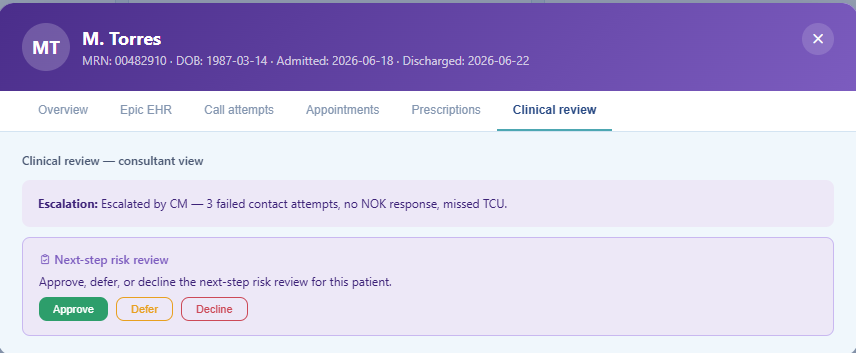
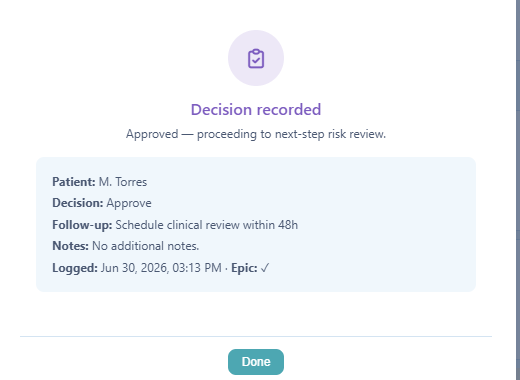
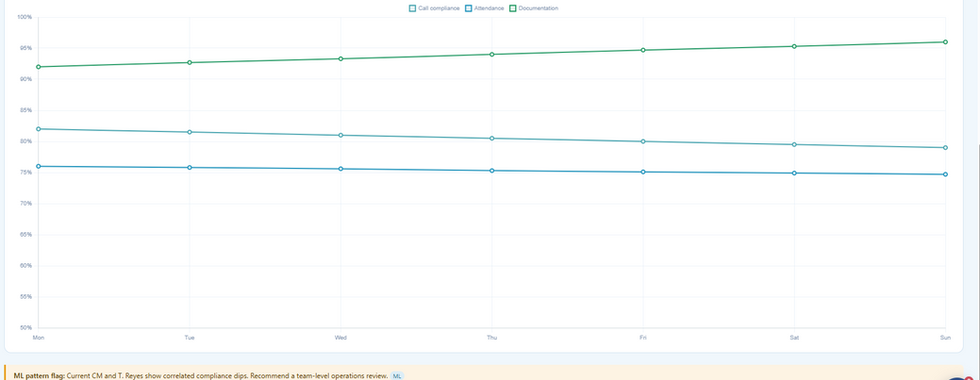
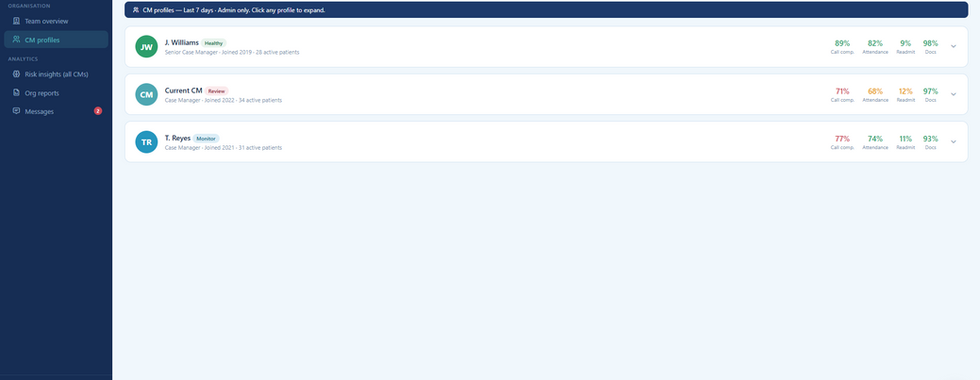
This manual coordination keeps the case manager focused on delivering the work rather than engaging with the patient. So, to solve this issue, I created a Case Management Dashboard prototype in Claude with full integration with EPIC.
Through the use of this dashboard, Case Managers, Consultants, and Admin staff can cut down on manual processes and focus on providing humane care to vulnerable patients.
Click any the link to interact with the dashboard
Case Manager Dashboard Screens


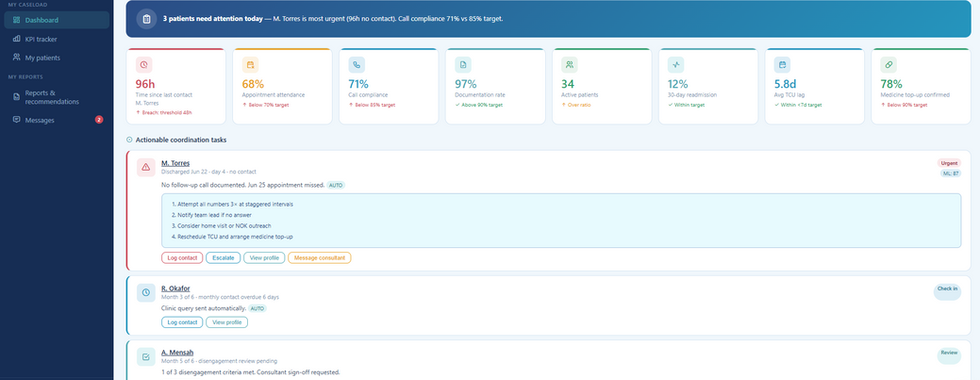



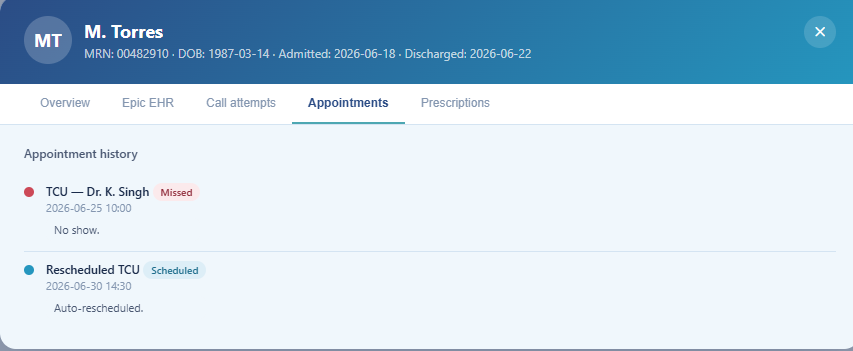


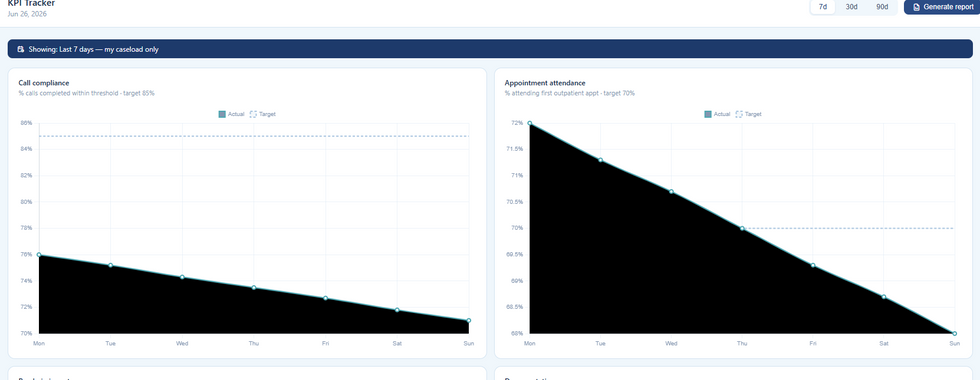


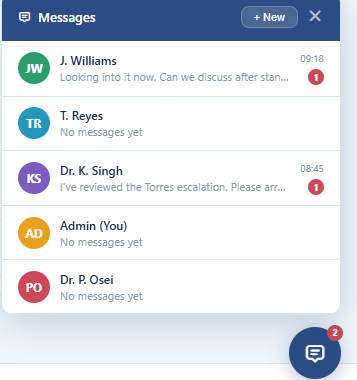
Consultant Dashboard Screens






Admin Dashboard Screens







For a video walkthrough, please visit the link below or watch video below.
Thank you for reading! If you have any questions or would like to meet with me, send me an email at:
Citations
Tai, A., Pincham, H., Basu, A., & Large, M. (2025). Meta-analysis of risk factors for suicide after psychiatric discharge and meta-regression of the duration of follow-up. The Australian and New Zealand Journal of Psychiatry, 59(8), 679. https://doi.org/10.1177/00048674251348372

Comments